


Robotics Training
The Robotics Training Program is an intensive, hands-on course designed to equip participants with the knowledge and skills needed to design, build, and program robots. The program covers essential topics such as robot kinematics, control systems, sensors, actuators, and automation.
Why Choose Skillairo?
Expert Mentor
Industry Exposure
LMS Access
Talk & Skills
Professional Certificate
Career Support
Programs Overview
The Robotics Training Program is an intensive, hands-on course designed to equip participants with the knowledge and skills needed to design, build, and program robots. The program covers essential topics such as robot kinematics, control systems, sensors, actuators, and automation. Participants will also learn about programming languages like Python, C++, and ROS (Robot Operating System) to develop robotic applications.
Ideal for engineers, developers, and technology enthusiasts, this program offers flexible learning options, expert guidance, and an industry-recognized certification. By the end of the course, participants will be prepared to develop and deploy robotic solutions in various industries, from manufacturing to healthcare and beyond.
Training Path
Introduction to Robotics and AI
What is Robotics and AI?
- Overview of Robotics Components
- AI in Robotics
- Applications of Robotics with AI
Robot Kinematics and Control with AI
- Basics of Robot Kinematics and Dynamics
- AI-Based Motion Control
- Using Reinforcement Learning for Path Optimization and Robot Behavior
- Hybrid Control Systems
Robot Learning and Autonomous Decision Making
- Supervised and Reinforcement Learning Algorithms in Robotics
- Implementing Decision Trees, SVM, and Q-Learning in Robotic Systems
- AI for Multi-Robot Coordination and Collaboration
- Deep Reinforcement Learning (DRL) for Autonomous Decision-Making
Natural Language Processing (NLP) for Human-Robot Interaction
- Basics of NLP and Speech Recognition for Robotics
- Enabling Robots to Understand and Respond to Human Commands
- AI Chatbots and Dialogue Systems for Human-Robot Interaction
- Gesture Recognition and Visual Communication for HRI
Fundamentals of Artificial Intelligence for Robotics
- Introduction to Machine Learning
- Overview of Neural Networks and Deep Learning
- Natural Language Processing (NLP) and Computer Vision for Robotics
- AI Algorithms for Path Planning, Motion Control, and Object Recognition
Computer Vision and Perception in Robotics
- Introduction to Computer Vision Techniques
- Deep Learning for Vision-Based Perception
- Real-Time Object Recognition and Tracking with AI
- SLAM (Simultaneous Localization and Mapping) and AI-enhanced Perception
AI-Powered Robot Localization and Navigation
- Overview of Localization Methods
- Integrating AI for Improved Robot Localization and Mapping
- AI Algorithms for Path Planning and Obstacle Avoidance
- Multi-modal Sensor Fusion for Robust Navigation
AI-Driven Robotics: Ethics, Safety, and Challenges
- Ethics in Robotics
- AI Safety in Robotics
- Addressing AI Challenges in Real-World Robotics Applications
- Ethical and Legal Issues in Autonomous Robotics
Skills Covered
- Robotics Basics
- Robot Kinematics
- Actuators and Sensors
- Control Systems
- Robot Programming
- Automation
- Mechatronics
- Robot Design
- Path Planning
- Robotic Vision
- Robotics Simulation
- Robotic Manipulation
Industry Projects
E-commerce Website
Build an online shopping platform with product listings, user authentication, payment gateways, and order management. Focus on a smooth user experience and backend inventory management.
Blog Platform
Create a platform for users to write and publish blog posts, with features like user profiles, commenting, content management, and social sharing. Implement a simple, intuitive interface for authors and readers.
Event Management System
Develop a system for organizing, promoting, and managing events. Include features such as event registration, ticketing, calendar integration, attendee management, and event notifications.
Social Media Platform
Build a platform that allows users to create profiles, post content, follow others, like and comment on posts, and engage in direct messaging. Focus on real-time interactions and scalability.
Restaurant Reservation System
Develop a system that allows customers to book tables, view menus, make reservations, and get notifications. Implement an admin panel for managing bookings and customer details.
This project focuses on developing an AI-powered autonomous robot capable of navigating and performing tasks in dynamic environments. The robot will utilize advanced machine learning algorithms, computer vision, and sensor integration to operate independently, adapt to new environments, and perform tasks with minimal human intervention. The key component include
1.System Architecture and Design Design the overall architecture of the autonomous robot, including its hardware (sensors, actuators, processing units) and software (AI algorithms, navigation, and control systems). The design should prioritize modularity for ease of upgrades and maintenance.
2.AI Algorithms and Decision Making Develop AI-based algorithms (such as deep learning, reinforcement learning, and computer vision) to enable the robot to make intelligent decisions based on real-time data. This includes tasks like path planning, object recognition, and dynamic obstacle avoidance.
3.Navigation and Localization Implement autonomous navigation systems, using technologies like Simultaneous Localization and Mapping (SLAM) and GPS (for outdoor applications), enabling the robot to understand and navigate its environment accurately and efficiently.
4.Sensor Integration and Perception Integrate various sensors (LiDAR, cameras, ultrasonic sensors, IMUs) to gather data about the robot’s environment. Use AI-powered perception algorithms to interpret the data, allowing the robot to identify objects, avoid obstacles, and understand its surroundings.
5.Control Systems and Motion Planning Develop motion planning and control systems that allow the robot to follow optimal paths, execute complex maneuvers, and maintain stability while navigating. This includes controlling the robot’s motors and actuators to achieve precise movements.
6.Human-Robot Interaction (HRI) Design and implement human-robot interaction interfaces, including speech recognition, gesture control, or mobile apps, enabling the robot to communicate and cooperate with humans in real-time.
7.Task Automation and Workflow Management Implement task automation capabilities, allowing the robot to autonomously perform specific tasks such as material handling, package delivery, or cleaning. This will include developing intelligent task prioritization and workflow management systems.
8.Energy Efficiency and Battery Management Develop an energy-efficient design to ensure the robot can operate for extended periods. Implement battery management algorithms that optimize power usage based on workload and environmental conditions.
9.Safety and Collision Avoidance Implement safety protocols and collision avoidance algorithms that ensure the robot operates safely in dynamic environments. This includes real-time hazard detection and reactive behaviors like stopping or rerouting to avoid accidents.
10.Data Monitoring, Logging, and Reporting Design systems for continuous data collection, logging, and reporting of robot activities, performance metrics, and environmental interactions. This includes remote monitoring for maintenance and diagnostics.
11.Regulatory Compliance and Standards Ensure that the autonomous robot complies with relevant safety regulations, industry standards, and ethical guidelines, including those related to autonomous systems, AI safety, and robotics certifications.
Technologies AI/ML Frameworks (e.g., TensorFlow, PyTorch, ROS for robot programming, OpenCV for computer vision),Sensors (LiDAR, cameras, ultrasonic, IMUs, depth sensors),Robot Operating System (ROS) for system integration,SLAM algorithms for navigation and localization,Embedded Systems for real-time control,Cloud Computing for data processing and remote monitoring.
Outcome A fully functional AI-powered autonomous robot that can navigate and perform tasks autonomously in a variety of environments. The robot will leverage AI for decision-making, perception, and movement, optimizing its efficiency and safety. It will be able to interact with humans and other devices, contributing to task automation, enhancing productivity, and offering a wide range of applications in industries like logistics, healthcare, and smart homes.

This project focuses on developing a facial recognition robot that can identify and authenticate individuals based on facial features. The robot will utilize advanced AI and machine learning algorithms for real-time face detection, recognition, and interaction, enabling applications in security, access control, and personalized services. The key component include
1.System Architecture and Design Design the overall architecture of the facial recognition robot, which includes the integration of hardware components (e.g., cameras, sensors, processors) and software systems (e.g., AI algorithms, user interfaces). The architecture should ensure high accuracy, low latency, and robustness.
2.Facial Recognition Algorithms Implement advanced machine learning algorithms (such as Convolutional Neural Networks – CNNs) for facial detection, feature extraction, and recognition. The system will identify and verify faces in various lighting conditions, angles, and occlusions.
3.Camera and Sensor Integration Integrate high-resolution cameras and 3D depth sensors to capture clear and accurate facial images. This includes setting up optimal camera placements and lighting for reliable recognition.
4.Face Detection and Tracking Develop real-time face detection and tracking systems that can identify multiple faces in a scene and follow individuals as they move. This includes handling dynamic environments with changing lighting or people’s positions.
5.AI-Powered Face Matching Design and implement AI-based face matching algorithms that compare captured facial features against a stored database of known individuals. This includes creating an efficient system for storing and managing biometric data securely.
6.User Interaction and Feedback Develop interfaces for user interaction, such as displaying feedback on the robot’s screen (e.g., “Access Granted” or “Face Not Recognized”) and using voice or gesture commands for real-time communication. The robot should be able to engage in conversations or respond to queries.
7.Security and Privacy Protocols Ensure robust security measures for data storage and transmission, particularly for facial data. Implement encryption, anonymization, and other privacy safeguards to comply with data protection regulations like GDPR.
8.Navigation and Mobility (Optional) If the robot needs to move or track individuals, implement navigation and mobility systems, including obstacle avoidance, path planning, and real-time movement coordination based on face detection.
9.Data Monitoring, Logging, and Reporting Design a system to log facial recognition events, including successful and failed recognition attempts. Provide analytics and reports on recognition accuracy, user activity, and system performance.
10.Regulatory Compliance and Standards Ensure that the facial recognition system complies with relevant privacy, ethical, and regulatory standards, such as biometric data protection laws, accuracy and fairness standards, and safety certifications for autonomous systems.
11.Testing and Performance Evaluation Develop rigorous testing protocols to evaluate the performance of the facial recognition system, including its accuracy, speed, and reliability under various conditions (e.g., different lighting, angles, or facial expressions).
Technologies AI/ML Frameworks (e.g., TensorFlow, Keras, OpenCV for facial detection and recognition),Cameras and Sensors (HD cameras, 3D depth sensors, infrared sensors for night vision),Facial Recognition Libraries (e.g., FaceNet, Dlib, OpenCV),Robot Operating System (ROS) for system integration (if mobility is required),Cloud Computing for storing facial data (with proper encryption and security protocols),Embedded Systems for real-time face detection and recognition processing.
Outcome A fully functional facial recognition robot capable of identifying and authenticating individuals based on facial features. The system will be able to operate in various environments, recognizing faces accurately and efficiently while ensuring privacy and security. The robot can be applied to areas such as access control, personalized customer service, and security surveillance, contributing to automation and improved user experiences.
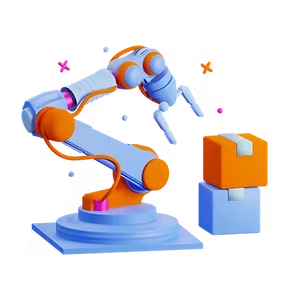
This project focuses on designing and implementing a robotic arm that leverages machine learning algorithms to enhance its precision, adaptability, and autonomy. The system will enable the robotic arm to learn from its environment, adapt to different tasks, and improve its performance over time, making it suitable for applications in manufacturing, assembly, healthcare, and more. The key component include
1.System Architecture and Design Design the overall architecture of the robotic arm system, including mechanical components (e.g., joints, actuators), control systems, sensors, and machine learning algorithms. The design should allow for flexibility in task execution and adaptability to various operational environments.
2.Machine Learning Algorithms Implement machine learning algorithms such as reinforcement learning (RL), supervised learning, or deep learning to enable the robotic arm to learn optimal movements, grasping techniques, and task execution strategies from experience and sensory feedback.
3.Robotic Arm Kinematics and Control Develop the kinematic model of the robotic arm, including inverse kinematics for precise positioning of the arm. Implement motion control algorithms to ensure smooth, accurate, and stable movement during tasks, such as picking, placing, or assembly.
4.Sensors and Perception Integrate sensors like cameras, force sensors, and tactile sensors to provide real-time feedback to the robot about its environment and the objects it interacts with. Machine learning will be used to process and interpret sensor data to guide decision-making and refine task performance.
5.Grasping and Object Manipulation Develop algorithms for adaptive grasping and object manipulation, enabling the robotic arm to pick up, hold, and manipulate objects with varying shapes, sizes, and materials. Machine learning techniques will allow the arm to improve its ability to handle unfamiliar or fragile objects.
6.Task Learning and Adaptation Use machine learning to allow the robotic arm to learn new tasks and adapt to changing environments. The robot can improve its execution over time through continuous learning, optimizing efficiency, and reducing errors based on feedback from its environment.
7.Path Planning and Obstacle Avoidance Implement path planning algorithms to optimize the movement of the robotic arm, ensuring efficient and collision-free motion. Machine learning will be used to adapt path planning based on environmental changes, such as obstacles or shifting task parameters.
8.Human-Robot Interaction (HRI) Develop interfaces for human-robot interaction, allowing users to train, control, or adjust the robotic arm via gestures, voice commands, or graphical interfaces. The robot should be able to receive instructions and respond to human inputs in a safe and intuitive manner.
9.Real-Time Performance Monitoring and Feedback Implement real-time performance monitoring, allowing for continuous tracking of the robotic arm’s operation, efficiency, and accuracy. This will include error detection and the ability to adjust tasks dynamically based on performance feedback.
10.Data Collection, Logging, and Reporting Design systems for data collection and logging, tracking parameters such as arm movements, task success rates, and environmental conditions. Generate reports on system performance, learning progress, and improvements over time.
11.Regulatory Compliance and Standards Ensure that the robotic arm meets relevant industry standards and safety regulations, including those related to robotic systems in the workplace, machine safety, and machine learning ethics. Implement safety protocols to prevent accidents or malfunctions during operation.
Technologies Machine Learning Frameworks (e.g., TensorFlow, PyTorch, OpenAI Gym for reinforcement learning),Robotic Control Frameworks (e.g., ROS for system integration and motion control),Computer Vision (e.g., OpenCV, YOLO for object detection and visual feedback),Path Planning Algorithms (e.g., A*, D* for navigation and obstacle avoidance),Force/Tactile Sensors (e.g., FSR, load cells, or torque sensors for feedback on object interaction),Embedded Systems for real-time control and sensor data processing,Cloud Computing for storing large datasets used for machine learning model training and performance optimization.
Outcome A fully functional robotic arm equipped with machine learning capabilities that can autonomously learn new tasks, adapt to changing environments, and improve its efficiency over time. The robot will be able to perform tasks like assembly, pick-and-place operations, and complex manipulations with high precision, while also adapting its behavior to new objects, tools, or environments. This system will enhance productivity and provide flexibility in various industrial, medical, and research applications.
This project focuses on creating a voice-activated personal assistant robot capable of understanding and responding to natural language commands. The robot will integrate advanced speech recognition, AI-driven decision-making, and robotics technology to perform tasks such as providing information, managing schedules, controlling smart devices, and more. The key component include
1.System Architecture and Design Design the overall architecture of the voice-activated personal assistant robot, integrating hardware (e.g., microphone, speaker, sensors, motors) and software systems (e.g., speech recognition, natural language processing, task management). The design should ensure a seamless interaction experience between the user and the robot.
2.Speech Recognition and Natural Language Processing (NLP) Implement advanced speech recognition algorithms to convert user voice commands into text. Use NLP algorithms to understand and process the text, enabling the robot to interpret the intent behind commands and provide appropriate responses or take actions.
3.Voice Synthesis and Response Generation Develop a voice synthesis system (text-to-speech) to enable the robot to respond verbally to user queries and commands. The responses should be natural and contextually relevant, and the system should allow for a conversational interface with users.
4.Task Management and Execution Design systems for task management, allowing the robot to schedule events, set reminders, manage to-do lists, and execute simple commands like turning on lights or controlling other connected smart devices. The robot will learn to adapt to the user’s preferences and priorities over time.
5.Context Awareness and Memory Integrate memory and context-awareness features, enabling the robot to remember past interactions, learn from user preferences, and offer personalized responses or actions based on accumulated knowledge. This includes maintaining context during a conversation to avoid confusion.
6.Voice Command Interpretation and Error Handling Implement robust systems for interpreting voice commands accurately, even in noisy environments or with varying accents. The system should also include error-handling protocols, recognizing when a command has not been understood or when clarification is needed.
7.User Interaction and Feedback Create intuitive interfaces for user interaction, such as voice commands, touch screen displays, or mobile app control. The robot should provide real-time feedback, such as visual cues or verbal responses, to inform the user of task progress or completion.
8.Smart Home Integration and IoT Connectivity Integrate the robot with smart home devices and IoT ecosystems, allowing it to control lighting, thermostats, entertainment systems, and security devices via voice commands. The robot should be able to learn about the user’s home environment and preferences for automation.
9.Navigation and Mobility (Optional) If the robot requires mobility, implement systems for navigation and movement, allowing the robot to move between rooms or locations. This includes obstacle avoidance, path planning, and adaptive behaviors based on the environment.
10.Data Collection, Logging, and Reporting Develop systems for continuous monitoring and logging of the robot’s activities, user interactions, and task execution. This data can be used for performance analysis, troubleshooting, and improving the robot’s functionality over time.
11.Security and Privacy Ensure the robot adheres to privacy and security protocols, especially in handling sensitive user data such as personal schedules, reminders, and preferences. Implement encryption and secure authentication methods for interactions and data storage.
Technologies Speech Recognition (e.g., Google Speech-to-Text, CMU Sphinx, or Azure Speech Service),Natural Language Processing (NLP) (e.g., spaCy, NLTK, or GPT-based models for understanding and generating responses),Text-to-Speech (TTS) (e.g., Google TTS, Amazon Polly, or DeepMind WaveNet for voice synthesis),Robotics Frameworks (e.g., ROS for integration of movement and sensors, if applicable),IoT Protocols (e.g., Zigbee, Z-Wave, MQTT for smart device communication),Cloud Services (for data processing, AI model storage, and user account management),Embedded Systems for real-time control and task management,Mobile App Development (for remote control and monitoring via smartphone).
Outcome A fully functional voice-activated personal assistant robot that can understand and execute natural language commands. The robot will offer a personalized experience by managing tasks, controlling smart devices, and providing verbal responses in real-time. It will integrate seamlessly into home environments, assisting with daily tasks, offering entertainment, managing schedules, and enhancing the convenience of smart home systems. The system will be adaptive, learning from user preferences and interactions to improve its performance and provide better assistance over time.
This project focuses on creating a smart surveillance robot that autonomously patrols and monitors an environment, using advanced sensors and AI algorithms to detect and respond to security threats. The robot will be equipped with capabilities for real-time video surveillance, anomaly detection, and interaction with security systems to enhance security and surveillance operations. The key component include
1.System Architecture and Design Design the overall architecture of the smart surveillance robot, integrating hardware (e.g., cameras, sensors, actuators, mobility systems) and software (e.g., AI algorithms, data processing, communication protocols). The design should focus on real-time monitoring, autonomous navigation, and seamless integration with existing security systems.
2.Autonomous Navigation and Mapping Implement autonomous navigation algorithms, such as Simultaneous Localization and Mapping (SLAM) or path planning, to allow the robot to patrol a designated area. The robot will navigate without human intervention, avoiding obstacles and following pre-defined patrol routes while adapting to changes in the environment.
3.Surveillance Cameras and Sensors Integrate high-resolution cameras (e.g., thermal, infrared, or HD cameras) for surveillance, along with other sensors (e.g., motion detectors, microphones, environmental sensors). These will capture visual and auditory data, enhancing the robot’s ability to detect intrusions, unusual activity, or environmental changes.
4.AI-Based Anomaly Detection and Threat Identification Implement AI algorithms, including computer vision (e.g., object detection, face recognition, and anomaly detection) to analyze real-time footage for potential security threats. The robot will be able to identify intruders, suspicious behavior, or unauthorized objects, alerting human security personnel when necessary.
5.Real-Time Data Processing and Alerts Design a system for real-time data processing, enabling the robot to analyze sensor and video data on-site or via cloud-based systems. The robot should generate alerts or notifications based on detected anomalies, sending alerts via email, mobile apps, or integration with security systems.
6.Communication and Remote Monitoring Develop communication protocols for remote control, monitoring, and data sharing. Security personnel should be able to view real-time footage, interact with the robot, or send instructions for specific tasks, such as adjusting patrol routes or focusing on specific areas.
7.Human-Robot Interaction (HRI) Create interfaces for human-robot interaction, enabling users to give commands or access information about the surveillance environment. This may include voice control, mobile apps, or web dashboards for monitoring and controlling the robot remotely.
8.Battery Management and Power Efficiency Implement energy-efficient systems and power management protocols, enabling the robot to operate autonomously for extended periods. This includes managing battery charge levels and ensuring the robot can return to charging stations when needed without human intervention.
9.Security and Data Privacy Ensure the robot adheres to security standards to protect both the robot’s communication and the data it collects. This includes encrypting video footage, user data, and alerts, as well as implementing authentication protocols for remote access.
10.Maintenance, Monitoring, and Reporting Develop systems for continuous monitoring and maintenance of the robot’s performance. This includes diagnostics for hardware issues, updates to software algorithms, and reporting on robot health and surveillance performance over time.
11.Regulatory Compliance and Standards Ensure the smart surveillance robot complies with relevant security, privacy, and safety regulations. This includes adhering to local laws regarding surveillance, data protection, and safety standards for autonomous systems. Technologies AI/ML Frameworks (e.g., TensorFlow, PyTorch, OpenCV for computer vision and anomaly detection),Robotics Frameworks (e.g., ROS for navigation and movement control),Surveillance Cameras (e.g., HD cameras, thermal imaging cameras, infrared sensors),SLAM Algorithms for autonomous mapping and navigation,IoT Communication Protocols (e.g., MQTT, Zigbee for device integration),Cloud
Services for data storage, remote access, and processing (if needed),Embedded Systems for real-time processing and control,Mobile App/Web Dashboards for remote monitoring and management.
Outcome A fully autonomous smart surveillance robot that can patrol designated areas, detect and respond to security threats, and provide real-time surveillance data. Equipped with AI-powered anomaly detection and integrated with surveillance systems, the robot enhances security by offering continuous monitoring, immediate threat identification, and seamless human-robot collaboration. The robot will also be adaptable, capable of operating in various environments, including homes, offices, factories, or public spaces.
Certifications
Get certified in Robotics through our program and receive both a Training Completion Certificate and an Internship Completion Certificate. The prestigious Top Performer Certificate is awarded to outstanding students who performed exceptionally well during both the training and internship phases.



Pricing Plan
At SkillAiro, we’re committed to making high-quality education accessible to all. We’ve structured our programs with transparent and competitive pricing to suit a variety of learning needs.
Robotics Industry Trends
These trends underscore India’s expanding role in the global Robotics landscape, supported by a robust IT industry and a growing pool of skilled professionals.
13.1% Annual Growth Rate

The robotics sector in India is experiencing notable growth, particularly in the industrial domain. Projections indicate that the industrial robotics market in India is expected to reach approximately USD 3,449.1 million by 2030, with a compound annual growth rate (CAGR) of 13.1% from 2025 to 2030.
Another analysis suggests that the market, valued at USD 3.59 billion in 2023, is anticipated to grow at a CAGR of 15%, reaching nearly USD 8.26 billion by 2030.
These variations in projections may stem from differing methodologies and market scopes.
Other Key Industry Trends
- Industrial robot installations in India reached a record 8,510 units in 2023, marking a 59% increase from the previous year.
- The Indian government’s Production Linked Incentive (PLI) scheme, set to run until 2025, subsidizes companies that create production capacity in sectors such as automotive, metal, pharmaceuticals, and food processing, encouraging the adoption of robotics.
- India is home to over 13,000 startups working in emerging technologies, including robotics, as of the end of the financial year 2023–24.
In India, robotics engineers earn an average annual salary of approximately ₹5.13 lakhs, with total compensation around ₹5.63 lakhs per year. Entry-level positions start at about ₹2 lakhs per year, while experienced professionals can earn up to ₹9.6 lakhs annually. Salaries vary by location, with Bangalore offering an average range of ₹2.3 lakhs to ₹13 lakhs per year, Gurgaon at ₹2 lakhs to ₹7.5 lakhs, and Pune at ₹1.8 lakhs to ₹10.5 lakhs.
The robotics industry in India is experiencing significant growth, with projections indicating a 15-20% increase in job opportunities across various sectors by 2025. In 2023, India installed a record 8,510 industrial robots, a 59% increase from the previous year, and ranked seventh worldwide in annual installations.
INR 2-13L Annual Salary

Student Testimonial

At SkillAiro, we’re committed to making high-quality education accessible to all. We’ve structured our programs with transparent and competitive pricing to suit a variety of learning needs.
Anamika ,
Web Developer
At SkillAiro, we’re committed to making high-quality education accessible to all. We’ve structured our programs with transparent and competitive pricing to suit a variety of learning needs.
Anamika ,
Web Developer
At SkillAiro, we’re committed to making high-quality education accessible to all. We’ve structured our programs with transparent and competitive pricing to suit a variety of learning needs.
Anamika ,
Web Developer
At SkillAiro, we’re committed to making high-quality education accessible to all. We’ve structured our programs with transparent and competitive pricing to suit a variety of learning needs.
Anamika ,
Web Developer
At SkillAiro, we’re committed to making high-quality education accessible to all. We’ve structured our programs with transparent and competitive pricing to suit a variety of learning needs.
Anamika ,
Web Developer
Our Alumni Work At
Our alumni are already pushing boundaries in their fields. Former students are excelling in high-profile industries and influencing the landscape of tomorrow.
RECOGNITION FROM



Frequently Asked Questions
What is a Robotics training?
A Robotics with AI program equips individuals with the knowledge and skills required to design, develop, and implement intelligent robotic systems. It typically covers topics such as robot kinematics, dynamics, control systems, machine learning, computer vision, reinforcement learning, and AI-based decision-making. The program often includes hands-on projects and real-world case studies, preparing learners for careers as Robotics Engineers, AI Specialists, or Automation Engineers.
What does a Robotics engineer do?
A Robotics Engineer with AI designs and develops robots that can perform tasks autonomously or with minimal human intervention. They combine principles of robotics with artificial intelligence to enable robots to learn from their environment, make decisions, and perform tasks like object recognition, path planning, and speech recognition. Robotics Engineers with AI expertise work in industries such as manufacturing, healthcare, logistics, and autonomous vehicles, creating intelligent systems that optimize efficiency and solve complex problems. Our Robotics with AI training program provides the technical expertise and practical experience needed to excel in this innovative field.
Who are the instructors for this Robotics training program, and how are they selected?
Our Robotics trainers are skilled professionals with extensive expertise in automation, robotic systems design, control systems, and AI-driven robotics applications. They bring hands-on experience from various industries, including manufacturing, healthcare, and autonomous systems, ensuring students learn practical and cutting-edge robotics techniques. We ensure that only trainers with exceptional alumni ratings and a proven history of delivering impactful training remain part of our faculty, providing students with the best learning experience in robotics and its diverse applications.
What will be the career path after completing the Robotics program online?
After completing an online Robotics with AI program, career paths include roles such as Robotics Engineer, AI Specialist, Machine Learning Engineer, Computer Vision Engineer, or Automation Engineer. With experience, you can progress to senior positions like Robotics Systems Architect, Lead AI Engineer, or Chief Robotics Officer. Opportunities are available in industries such as manufacturing, healthcare, autonomous vehicles, defense, and research and development.
Which industries use Robotics the most?
Robotics with AI is widely used in industries such as manufacturing, healthcare, autonomous vehicles, logistics, agriculture, and defense. Sectors like entertainment, construction, and research & development also rely heavily on intelligent robotics to improve automation, precision, and productivity. This Robotics with AI certification program is ideal for individuals looking to build a career in these rapidly evolving and high-demand fields.
Can I pay the fee in installments?
Yes, you can secure your spot by paying a pre-registration fee of 1000 INR. The remaining balance can be paid before the program begins.
Will I get an internship?
Yes, at Skillairo, we offer guaranteed internship opportunities for all students across all our courses, providing hands-on experience to enhance their learning and career prospects.
How long is the training?
Our Self-paced and Mentor-led training program both last for a period of 2-3 months. Our Advanced training program last for a period of 4 months.
Talk to Expert
At Skillairo, we help students and aspiring professionals gain industry-ready skills through expert-led training, hands-on projects, internships, and career guidance.