



Operation Management Training
The Operations Management Training Program is a hands-on course designed to provide participants with the knowledge and skills needed to efficiently manage business operations. It covers key topics such as supply chain management, process optimization, production planning, inventory management, quality control, and lean management techniques.
Why Choose Skillairo?
Expert Mentor
Industry Exposure
LMS Access
Talk & Skills
Professional Certificate
Career Support
Programs Overview
The Operations Management Training Program is a hands-on course designed to provide participants with the knowledge and skills needed to efficiently manage business operations. It covers key topics such as supply chain management, process optimization, production planning, inventory management, quality control, and lean management techniques. Participants will also learn about project management, cost reduction strategies, and the use of technology in streamlining operations.
Ideal for aspiring operations managers, business analysts, and professionals in manufacturing, logistics, and service industries, this program offers flexible learning options, expert mentorship, and an industry-recognized certification. By the end of the course, participants will be well-equipped to manage operations, optimize processes, and contribute to the success of an organization.
Training Path
Introduction to Operations Management
What is Operations Management?
- The Role of Operations Management in Organizations
- Key Functions of Operations
- Overview of the Operations Value Chain
Product and Service Design
- Fundamentals of Product and Service Design
- Design for Manufacturability and Sustainability
- Tools for Product Development
- Service Design and Innovation in Operations Management
Production and Process Management
- Overview of Production Systems
- Process Flow and Layout Planning
- Managing Capacity, Resources, and Throughput
- Process Improvement Techniques
Quality Management and Continuous Improvement
- Quality Control and Quality Assurance in Operations
- Total Quality Management (TQM) and its Implementation
- Statistical Process Control (SPC), Control Charts, and Capability Analysis
- Continuous Improvement Methodologies
Operations Strategy and Competitiveness
- Developing an Operations Strategy Aligned with Business Goals
- Strategic Decision Making in Operations
- Understanding Competitive Priorities
- Case Studies on Successful Operations Strategies in Leading Companies
Supply Chain Management and Logistics
- Introduction to Supply Chain Management (SCM)
- Key Components of the Supply Chain
- Logistics and Distribution Networks
- Supply Chain Optimization
Inventory Management and Control
- Fundamentals of Inventory Management
- Inventory Control Systems
- Just-In-Time (JIT) and Lean Inventory Management
- Technology in Inventory Management
Forecasting and Capacity Planning
- Techniques for Demand Forecasting
- Capacity Planning
- Aggregate Planning
- Simulation and Forecasting Software Tools
Skills Covered
- Process Optimization
- Inventory Control
- Logistics Planning
- Lean Operations
- Six Sigma
- Quality Management
- Production Planning
- Demand Forecasting
- Capacity Planning
- Workflow Automation
- Project Management
- Resource Allocation
Industry Projects
E-commerce Website
Build an online shopping platform with product listings, user authentication, payment gateways, and order management. Focus on a smooth user experience and backend inventory management.
Blog Platform
Create a platform for users to write and publish blog posts, with features like user profiles, commenting, content management, and social sharing. Implement a simple, intuitive interface for authors and readers.
Event Management System
Develop a system for organizing, promoting, and managing events. Include features such as event registration, ticketing, calendar integration, attendee management, and event notifications.
Social Media Platform
Build a platform that allows users to create profiles, post content, follow others, like and comment on posts, and engage in direct messaging. Focus on real-time interactions and scalability.
Restaurant Reservation System
Develop a system that allows customers to book tables, view menus, make reservations, and get notifications. Implement an admin panel for managing bookings and customer details.

This project focuses on building a system to optimize inventory management by streamlining stock tracking, demand forecasting, and order management. The system ensures cost efficiency, reduces stockouts, and prevents overstocking. The key component include
1.Inventory Tracking Enable real-time tracking of inventory levels, including stock in hand, reorder levels, and stock movement, ensuring accurate and updated records.
2.Demand Forecasting Use historical sales data and predictive analytics to forecast future demand, enabling better planning and inventory allocation.
3.Automated Reorder Management Implement automated alerts and purchase order generation when stock levels reach predefined thresholds, preventing stockouts.
4.Supplier and Purchase Order Management Manage supplier information, track purchase orders, and monitor supplier performance to ensure timely procurement.
5.Multi-Location Inventory Management Provide centralized tracking and control of inventory across multiple warehouses or locations, ensuring efficient stock distribution.
6.Analytics and Reporting Generate detailed reports and insights on inventory turnover, stock aging, demand patterns, and cost analysis to aid decision-making.
7.Barcode/QR Code Integration Support barcode or QR code scanning for efficient inventory updates, stock audits, and tracking of product movement.
8.User Role Management Implement role-based access control to ensure data security and allow multiple user roles, such as managers, warehouse staff, and procurement teams.
Technologies Python, Django/Flask, PostgreSQL/MySQL (database), Pandas (for analytics), React.js/Angular (frontend), APIs for integration with ERP systems, and Barcode/QR code libraries (e.g., Zxing or Pyzbar).
Outcome An optimized inventory management system that enhances operational efficiency, reduces carrying costs, minimizes stockouts, and ensures a seamless supply chain process.

This project focuses on developing a comprehensive analytics dashboard to monitor and optimize supply chain operations. The system provides real-time insights into key supply chain metrics, enhances decision-making, and identifies opportunities for cost reduction and efficiency improvements. The key component include
1.Real-Time Supply Chain Monitoring Track real-time data on inventory levels, shipment statuses, order fulfillment, and production schedules, providing an overview of supply chain health.
2.Supplier Performance Analysis Analyze supplier performance based on delivery timelines, quality metrics, and cost efficiency to identify reliable partners and improve procurement strategies.
3.Demand and Supply Forecasting Leverage historical data and predictive analytics to forecast demand and align supply chain operations accordingly, minimizing stockouts and overproduction.
4.Cost Analysis and Optimization Monitor costs across the supply chain, including transportation, warehousing, and production, to identify cost-saving opportunities.
5.Logistics and Transportation Insights Track shipment routes, delivery times, and logistics efficiency to improve transportation planning and reduce delays.
6.Key Performance Indicator (KPI) Dashboard Display critical KPIs, such as order cycle time, inventory turnover, and fill rate, on a visually intuitive dashboard for quick decision-making.
7.Scenario Analysis and Risk Management Simulate different supply chain scenarios to assess potential risks, such as demand surges or supplier disruptions, and develop contingency plans.
8.Integration with ERP and IoT Systems Connect with Enterprise Resource Planning (ERP) and IoT systems to gather data from various supply chain nodes and ensure seamless data flow.
Technologies Python, Tableau/Power BI, Pandas and NumPy (data analysis), SQL (data management), Flask/Django (backend), React.js/Angular (frontend), and APIs for ERP/IoT integration.
Outcome A robust supply chain analytics dashboard that provides actionable insights, improves operational efficiency, enhances demand-supply alignment, reduces costs, and fosters data-driven decision-making across the supply chain network.
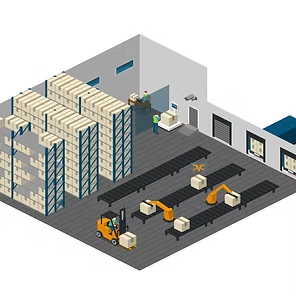
This project focuses on designing and simulating an optimal warehouse layout to improve storage, material handling, and overall operational efficiency. The system helps warehouse managers visualize and analyze different layout designs, improving space utilization, reducing movement time, and enhancing workflow. The key component include
1.Warehouse Space Optimization Design a layout that maximizes storage capacity while ensuring efficient use of available space.Incorporate storage techniques such as binning, shelving, and pallet racking for different types of products.
2.Material Flow Simulation Simulate the flow of materials through the warehouse, from receiving to storage and shipping, to identify bottlenecks and areas for improvement.Optimize picking, packing, and staging areas to minimize the time and cost of moving goods.
3.Storage Strategy Analysis Implement strategies like Random Storage, Fixed Location Storage, or Zone Picking to determine the most efficient way to store products. Consider product characteristics (e.g., size, weight, demand frequency) in deciding storage location assignments.
4.Order Picking Efficiency Simulate and optimize picking strategies (e.g., Single Order Picking, Batch Picking, or Cluster Picking) to reduce travel time and increase productivity.Assess and optimize the layout of picking zones to reduce congestion and improve throughput.
5.Material Handling System Design Design and simulate material handling equipment, such as conveyors, forklifts, and Automated Guided Vehicles (AGVs), to streamline material flow and enhance operational efficiency.Analyze the balance between human and machine labor to optimize warehouse operations.
6.Safety and Accessibility Design Ensure that the warehouse layout allows for easy access to all storage areas while maintaining safety standards.Consider aisle width, emergency exits, and safety equipment placement to reduce accidents and ensure compliance.
7.Space Utilization and Inventory Management Optimize the placement of high-turnover inventory in easily accessible locations to reduce picking times.Implement dynamic slotting techniques to adjust storage locations based on product demand trends.
8.Simulation and Scenario Analysis Use simulation tools to visualize how different layout configurations perform under varying conditions (e.g., changing order volumes, seasonal demand). Assess the impact of layout changes on key performance indicators such as throughput, labor costs, and order fulfillment times.
Technologies: Python (for simulation modeling and data analysis) AutoCAD/SketchUp (for layout design) Arena/AnyLogic (for warehouse simulation) Tableau/Power BI (for visualizing simulation results) SQL (for managing and querying inventory data) IoT Sensors (for real-time data collection) Flask/Django (backend for integration with WMS) React.js
Outcome A data-driven warehouse layout design that optimizes space, reduces handling time, and enhances operational efficiency.The ability to simulate and test different layout scenarios to make informed decisions before physical implementation.Improved order fulfillment speed, reduced operational costs, and enhanced safety standards within the warehouse.

This project aims to develop a demand forecasting system for retail operations, enabling businesses to predict future customer demand accurately. By leveraging historical data and machine learning models, the system helps optimize inventory levels, reduce stockouts, and minimize excess inventory costs. The key component include
1.Data Collection and Preprocessing Gather historical sales data, seasonal trends, promotions, and external factors such as weather or economic conditions. Clean and preprocess the data to handle missing values, remove outliers, and ensure consistency.
2.Exploratory Data Analysis (EDA) Perform EDA to identify demand patterns, seasonality, and correlations between different variables that impact demand.
3.Demand Prediction Models Implement machine learning models such as ARIMA, Prophet, or Long Short-Term Memory (LSTM) networks to predict future demand. Models can be tailored for specific product categories or stores.
4.Segmentation-Based Forecasting Segment products or stores based on factors like sales volume, location, or category to develop targeted and more accurate forecasts.
5.Scenario Analysis Simulate various scenarios, such as promotions, pricing changes, or supply chain disruptions, to assess their impact on demand.
6.Inventory Optimization Use demand forecasts to optimize inventory levels, ensuring adequate stock availability while minimizing holding costs.
7.Visualization and Reporting Develop a dashboard to display demand trends, forecast accuracy, and key metrics such as stock-to-sales ratios and replenishment schedules.
8.Real-Time Forecast Updates Incorporate real-time data inputs and continuously update demand forecasts to adapt to changing market conditions.
Technologies Python, Pandas, NumPy, Scikit-learn, TensorFlow/Keras, ARIMA/Prophet (forecasting models), Tableau/Power BI, Flask/Django (backend), and SQL (database management).
Outcome A demand forecasting system that empowers retail businesses to make data-driven decisions, optimize inventory management, enhance customer satisfaction by ensuring product availability, and improve overall operational efficiency.

This project focuses on building a workforce scheduling system to optimize employee work schedules, ensuring operational efficiency and fair distribution of workloads. The system leverages data analytics and optimization techniques to match workforce availability with organizational requirements. The key component include
1.Employee Availability Management Collect and manage employee availability data, including working hours, preferred shifts, and time-off requests.
2.Shift Scheduling Automatically generate shift schedules based on employee availability, required roles, and workload distribution while minimizing scheduling conflicts.
3.Skill-Based Assignment Assign tasks or shifts to employees based on their skill sets, certifications, and experience levels to ensure the right person is assigned to the right job.
4.Compliance and Labor Law Adherence Ensure schedules comply with labor laws, including maximum work hours, mandatory breaks, and overtime regulations.
5.Real-Time Adjustments Enable real-time updates to schedules in response to unexpected changes, such as employee absences or surges in demand.
6.Forecasting Workload Predict future workforce needs based on historical data, seasonal trends, and business forecasts, enabling proactive scheduling.
7.Visualization and Reporting Provide dashboards to visualize workforce utilization, shift coverage, and employee performance. Generate reports on overtime, absenteeism, and labor costs.
8.Mobile and Employee Portal Access Allow employees to view their schedules, swap shifts, request time off, and receive notifications through a mobile app or web portal.
Technologies Python, Flask/Django (backend), React/Angular (frontend), PostgreSQL/MySQL (database), Pandas, Scikit-learn (forecasting), Google Calendar API, Firebase (real-time updates), and AWS/Azure (deployment).
Outcome A workforce scheduling system that improves efficiency by optimizing shift assignments, ensuring compliance with labor laws, enhancing employee satisfaction, and reducing operational costs through effective planning and utilization of resources.
Certifications
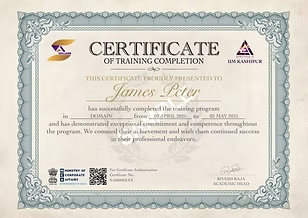
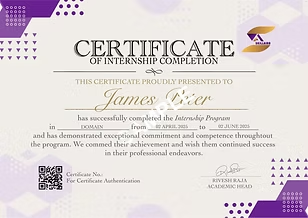
Get certified in Operation management through our program and receive both a Training Completion Certificate and an Internship Completion Certificate. The prestigious Top Performer Certificate is awarded to outstanding students who performed exceptionally well during both the training and internship phases.

Pricing Plan
At SkillAiro, we’re committed to making high-quality education accessible to all. We’ve structured our programs with transparent and competitive pricing to suit a variety of learning needs.
Operation management Industry Trends
These trends underscore India’s expanding role in the global Operation management landscape, supported by a robust IT industry and a growing pool of skilled professionals.
18.4% Annual Growth Rate

India’s Manufacturing Operations Management (MOM) software market is experiencing significant growth. In 2023, the market was valued at approximately USD 780.1 million and is projected to reach USD 2,546.6 million by 2030, reflecting a CAGR of 18.4% from 2024 to 2030.
Similarly, the Development to Operations (DevOps) market in India is expanding rapidly. In 2023, it was valued at around USD 567.2 million and is expected to grow to USD 2,287.1 million by 2030, with a CAGR of 22% during the same period.
Other Key Industry Trends
- India accounted for 2.8% of the global operations management software market revenue in 2020.
- The U.S. is forecasted to lead the global operations management market in revenue by 2027.
- In the Asia Pacific region, China is expected to dominate the operations management sector by 2027.
- India is the fastest-growing operations management market in Asia Pacific, driven by increasing automation and supply chain optimization, with significant projected growth by 2027.
Operations Managers in India earn an average annual salary of ₹7.0 lakhs, with entry-level roles starting at ₹3.2 lakhs and experienced professionals earning up to ₹24.0 lakhs. Salaries vary by city, with Bengaluru offering the highest average at ₹9.1 lakhs. Industries like Software and IT Services provide higher salaries, averaging ₹12.5 lakhs and ₹10.9 lakhs, respectively.
The sector is growing rapidly, driven by infrastructure and industrial investments. For instance, IndoSpace plans a 41% investment increase in Tamil Nadu, creating over 8,000 jobs in operations management.
INR 3.2-24 L Annual Salary

Student Testimonial

At SkillAiro, we’re committed to making high-quality education accessible to all. We’ve structured our programs with transparent and competitive pricing to suit a variety of learning needs.
Anamika ,
Web Developer
At SkillAiro, we’re committed to making high-quality education accessible to all. We’ve structured our programs with transparent and competitive pricing to suit a variety of learning needs.
Anamika ,
Web Developer
At SkillAiro, we’re committed to making high-quality education accessible to all. We’ve structured our programs with transparent and competitive pricing to suit a variety of learning needs.
Anamika ,
Web Developer
At SkillAiro, we’re committed to making high-quality education accessible to all. We’ve structured our programs with transparent and competitive pricing to suit a variety of learning needs.
Anamika ,
Web Developer
At SkillAiro, we’re committed to making high-quality education accessible to all. We’ve structured our programs with transparent and competitive pricing to suit a variety of learning needs.
Anamika ,
Web Developer
Our Alumni Work At
Our alumni are already pushing boundaries in their fields. Former students are excelling in high-profile industries and influencing the landscape of tomorrow.
RECOGNITION FROM



Frequently Asked Questions
What is a Operation management training?
An Operations Management program equips individuals with the skills and knowledge required to oversee and improve organizational processes and systems. It typically covers topics such as supply chain management, production planning, quality control, inventory management, process optimization, and project management. The program often includes case studies, simulations, and practical tools, preparing learners for careers as Operations Managers, Supply Chain Analysts, or Process Improvement Specialists.
What does a Operation management professional do?
An Operations Manager is responsible for overseeing and optimizing the day-to-day activities of a business or organization. They manage processes such as production, supply chain, inventory, and quality assurance to ensure efficient and cost-effective operations. Operations Managers are also involved in strategic planning, resource allocation, and problem-solving to improve performance and meet organizational goals. Our operations management training program provides the technical expertise and hands-on experience required to excel in this role.
Who are the instructors for this Operation management training program, and how are they selected?
Our Operations Management trainers are seasoned professionals with extensive expertise in supply chain management, process optimization, quality control, and strategic planning. They bring real-world experience from diverse industries, offering students practical insights into managing and improving operational efficiency. We ensure that only trainers with exceptional alumni ratings and a proven track record of delivering high-quality training remain part of our faculty, providing students with the best learning experience in operations management.
What will be the career path after completing the Operation management program online?
After completing an online Operations Management program, career paths include roles such as Operations Manager, Supply Chain Manager, Logistics Coordinator, Process Improvement Specialist, or Production Planner. With experience, you can progress to senior positions like Director of Operations, Chief Operations Officer (COO), or Vice President of Operations. Opportunities are available across industries like manufacturing, retail, logistics, healthcare, and technology.
Which industries use Operation management the most?
Operations Management is crucial across industries such as manufacturing, logistics, retail, healthcare, technology, and hospitality. Sectors like construction, e-commerce, automotive, and finance also rely on operations professionals to ensure smooth and efficient processes. This operations management certification program is ideal for individuals seeking to build a career in these high-demand sectors.
Can I pay the fee in installments?
Yes, you can secure your spot by paying a pre-registration fee of 1000 INR. The remaining balance can be paid before the program begins.
Will I get an internship?
Yes, at Skillairo, we offer guaranteed internship opportunities for all students across all our courses, providing hands-on experience to enhance their learning and career prospects.
How long is the training?
Our Self-paced and Mentor-led training program both last for a period of 2-3 months. Our Advanced training program last for a period of 4 months.
Talk to Expert
At Skillairo, we help students and aspiring professionals gain industry-ready skills through expert-led training, hands-on projects, internships, and career guidance.