




Embedded Systems Training
The Embedded Systems Training Program is an intensive, hands-on course designed to equip participants with the knowledge and skills needed to design, develop, and deploy embedded systems. The program covers essential topics such as microcontrollers, real-time operating systems (RTOS), hardware interfacing, sensors, actuators, and communication protocols.
Why Choose Skillairo?
Expert Mentor
Industry Exposure
LMS Access
Talk & Skills
Professional Certificate
Career Support
Programs Overview
The Embedded Systems Training Program is an intensive, hands-on course designed to equip participants with the knowledge and skills needed to design, develop, and deploy embedded systems. The program covers essential topics such as microcontrollers, real-time operating systems (RTOS), hardware interfacing, sensors, actuators, and communication protocols. Participants will also learn programming languages like C, C++, and Python, along with development tools and techniques used in embedded systems design.
Ideal for engineers, developers, and technology enthusiasts, this program offers flexible learning options, expert guidance, and an industry-recognized certification. By the end of the course, participants will be prepared to design and implement embedded systems for various applications, from consumer electronics to industrial automation and the Internet of Things (IoT).
Training Path
Introduction to Embedded Systems
What are Embedded Systems?
- Overview of Embedded System Architecture
- Applications of Embedded Systems
- Key Characteristics of Embedded Systems
Embedded System Design and Development
- Embedded System Design Flow
- Writing and Compiling Embedded Code
- Hardware-Software Interface
- Introduction to Embedded IDEs
Peripherals and Communication Protocols
- Understanding Peripherals
- Communication Protocols
- Interfacing Sensors and Actuators with Microcontrollers
- Using Protocols for Data Transmission and Communication
Real-Time Operating Systems (RTOS)
- What is an RTOS and How Does It Work?
- Task Scheduling, Priority, and Time Management in RTOS
- Using RTOS for Multitasking and Multi-threading in Embedded Systems
- Popular RTOS Options
Microcontrollers and Microprocessors
- Understanding the Basics of Microcontrollers (MCUs) and Microprocessors
- Popular Microcontrollers: Arduino, Raspberry Pi, PIC, ARM Cortex
- Comparison Between Microcontrollers and Microprocessors
- Introduction to Embedded Development Boards
Embedded Systems Programming
- Introduction to C/C++ for Embedded Systems
- Working with Embedded OS
- Interrupts, Timers, and Event Handling in Embedded Systems
- Managing Memory and Resources in Embedded Systems
Embedded System Architecture and Hardware Design
- Overview of Embedded System Components
- Hardware Design
- Power Consumption Optimization in Embedded Systems
- Troubleshooting and Debugging Embedded Systems
Embedded Systems Debugging and Testing
- Debugging Techniques for Embedded Systems
- Unit Testing and Hardware-in-the-Loop (HIL) Testing
- Use of Simulation Tools and Emulators for Embedded Development
- Automated Testing in Embedded Systems Development
Skills Covered
- Embedded System
- Microcontroller Progr..
- Digital Electronics
- Analog Electronics
- Interrupts and Timers
- RTOS
- Sensor Integration
- Power Management
- PCB Design
- Firmware Development
- IoT Integration
- Device Drivers
Industry Projects
E-commerce Website
Build an online shopping platform with product listings, user authentication, payment gateways, and order management. Focus on a smooth user experience and backend inventory management.
Blog Platform
Create a platform for users to write and publish blog posts, with features like user profiles, commenting, content management, and social sharing. Implement a simple, intuitive interface for authors and readers.
Event Management System
Develop a system for organizing, promoting, and managing events. Include features such as event registration, ticketing, calendar integration, attendee management, and event notifications.
Social Media Platform
Build a platform that allows users to create profiles, post content, follow others, like and comment on posts, and engage in direct messaging. Focus on real-time interactions and scalability.
Restaurant Reservation System
Develop a system that allows customers to book tables, view menus, make reservations, and get notifications. Implement an admin panel for managing bookings and customer details.

This project focuses on designing and implementing a home automation system using Arduino microcontrollers to control and monitor various home appliances and devices. The system will enable users to automate everyday tasks, such as controlling lighting, temperature, security, and entertainment systems, through physical interfaces or remote control via smartphones or voice commands. The key component include
1.System Architecture and Design Design the architecture of the home automation system, integrating Arduino microcontrollers with various sensors, actuators, and communication modules. The system should be modular to support future upgrades and additions, such as adding new devices or functionalities.
2.Device Control and Automation Develop control systems for automating home appliances, such as lights, fans, doors, or even kitchen devices. Use Arduino to interface with relays or smart plugs to turn devices on or off based on user input or preset schedules.
3.Sensor Integration and Monitoring Integrate sensors (e.g., motion detectors, temperature sensors, humidity sensors, light sensors) to monitor the home environment. These sensors will provide real-time data to the Arduino, enabling it to make intelligent decisions for automation tasks (e.g., adjusting thermostat settings or activating lights when motion is detected).
4.User Interface for Control Develop interfaces for controlling the system, such as a smartphone app, web interface, or physical buttons. The app could allow users to control devices remotely via Wi-Fi or Bluetooth, and view real-time data from sensors (e.g., current room temperature, lighting status).
5.Voice Control Integration Integrate voice control capabilities with popular virtual assistants (e.g., Amazon Alexa, Google Assistant) using platforms like Arduino and voice recognition modules. This will allow users to control their home appliances using voice commands.
6.Automation Schedules and Triggers Create automation schedules and triggers based on time of day, user behavior, or environmental conditions. For example, lights could turn on automatically when motion is detected in a room, or the thermostat could adjust based on time or temperature.
7.Security and Safety Features Implement security features such as door/window sensors, motion detection, or surveillance camera integration. Arduino can monitor for security events and send alerts to the user’s phone or activate alarms if unauthorized access is detected.
8.Energy Management and Efficiency Develop systems for monitoring and optimizing energy use, such as tracking the power consumption of appliances and adjusting usage patterns based on real-time data. This could include automatically turning off lights or appliances when not in use, helping users reduce their energy consumption.
9.Communication and Connectivity Implement communication protocols such as Wi-Fi, Bluetooth, or Zigbee to enable remote control and monitoring. This will allow devices to communicate with a central hub, smartphone, or cloud-based server for user interaction.
10.Data Logging and Reporting Design a data logging system to track system activity and sensor data over time. The system could generate reports on energy usage, appliance activity, and sensor data, helping users analyze and optimize their home automation system.
11.Regulatory Compliance and Safety Ensure the system complies with local electrical and safety regulations. Implement fail-safe mechanisms, such as overcurrent protection, circuit breakers, and automatic disconnection, to ensure safe operation of home appliances.
Technologies Arduino IDE for programming the microcontroller,Sensors (e.g., PIR motion sensors, DHT11 for temperature/humidity, LDR for light intensity),Communication Modules (e.g., Wi-Fi module like ESP8266, Bluetooth, Zigbee for connectivity),Relays for controlling high-voltage appliances,Smartphone App/Cloud Integration (e.g., Blynk, ThingSpeak for remote control and monitoring),Voice Assistants Integration (e.g., Amazon Alexa or Google Assistant with Arduino),Power Management Modules (e.g., current sensors, energy meters for energy tracking),Embedded Systems for real-time control and sensor interfacing.
Outcome A fully functional home automation system using Arduino that enables users to control and automate home appliances and monitor environmental conditions. The system will provide the convenience of remote control through smartphones or voice commands, offer energy-efficient solutions, and improve home security through sensor integration. The automation system can be easily expanded or modified to accommodate new devices or advanced functionalities, providing an adaptable solution for modern smart homes.
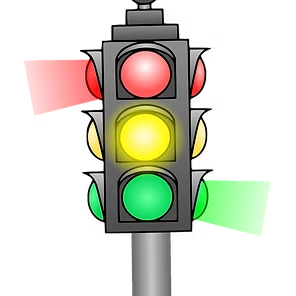
This project focuses on designing and implementing a traffic light control system to efficiently manage traffic flow at intersections. The system will use sensors and algorithms to control the timing of traffic lights, minimizing congestion, reducing wait times, and improving overall traffic efficiency. The key component include
1.System Architecture and Design Design the architecture of the traffic light control system, integrating traffic signal controllers, sensors, and communication modules. The system should support real-time decision-making and allow for flexibility in managing different types of intersections (e.g., T-junctions, four-way intersections, pedestrian crossings).
2.Traffic Light Control Algorithms Develop algorithms to control the sequence of traffic light signals (green, yellow, red) based on real-time traffic conditions. This may include fixed-time scheduling, adaptive control based on vehicle flow, and emergency vehicle prioritization.
3.Sensor Integration for Traffic Detection Integrate sensors (e.g., inductive loop sensors, infrared sensors, cameras) to detect the presence of vehicles at intersections. These sensors will provide real-time data on traffic conditions, enabling dynamic traffic light adjustments (e.g., extending green light for busy lanes).
4.Pedestrian and Bicycle Crossing Control Implement control for pedestrian and bicycle traffic, ensuring safe crossings at intersections. This may involve buttons or sensors that detect pedestrians/bicycles, activating the appropriate signal and providing dedicated time for crossing.
5.Emergency Vehicle Detection and Prioritization Integrate a system for detecting emergency vehicles (e.g., fire trucks, ambulances) and giving them priority at intersections. This could involve sensors or communication with emergency vehicles, allowing the system to change the signal sequence to facilitate quicker passage.
6.Traffic Light Timing and Optimization Develop timing strategies to optimize the traffic light cycles. This could include dynamic light duration based on traffic flow, such as extending green lights when traffic is heavy or shortening them during off-peak times.
7.Data Logging and Monitoring Implement data logging to monitor the system’s performance, including traffic volume, signal changes, and sensor status. This data can be used for traffic analysis and further system optimization.
8.Remote Monitoring and Control Design a remote monitoring and control interface to allow traffic management authorities to oversee the system’s performance and make adjustments remotely. This can include real-time traffic data, signal status, and emergency intervention options.
9.Traffic Flow Simulation and Testing Develop simulation models to test and validate the system under various traffic conditions. This will ensure that the system performs effectively in different scenarios (e.g., peak hours, accidents, road closures).
10.Safety and Reliability Ensure that the system includes safety features, such as backup power (e.g., UPS) in case of power failure, fault detection, and manual override options for maintenance or emergencies.
11.Regulatory Compliance and Standards Ensure that the system complies with local and international traffic signal standards and regulations, including those for vehicle and pedestrian safety, environmental considerations, and communication protocols.
Technologies Microcontrollers (e.g., Arduino, Raspberry Pi, or PLC for control),Sensors (e.g., inductive loop sensors, infrared sensors, cameras for vehicle detection),Traffic Light Controllers (e.g., relay-based controllers, smart controllers for signal timing),Communication Modules (e.g., GSM, Zigbee, or Wi-Fi for remote monitoring and communication),Software Tools (e.g., MATLAB/Simulink for traffic flow modeling and optimization),Embedded Systems for real-time control and sensor integration,Simulation Tools (e.g., VISSIM, AIMSUN for traffic simulation),Power Backup Systems (e.g., uninterruptible power supply (UPS) systems).
Outcome A fully functional traffic light control system that optimizes traffic flow at intersections, reduces congestion, and ensures the safety of vehicles and pedestrians. The system will dynamically adjust signal timing based on real-time traffic conditions and prioritize emergency vehicles when necessary. The integration of remote monitoring and control will allow traffic management authorities to manage and optimize the system efficiently. The system will be reliable, secure, and scalable, with the potential to integrate additional features, such as adaptive signal control and communication with connected vehicles.
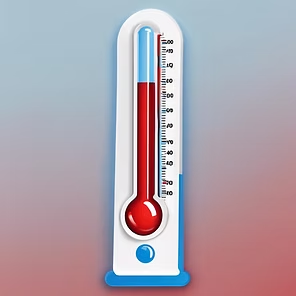
This project focuses on designing and implementing a temperature monitoring system that uses sensors to measure and track temperature variations in a specific environment. The system will provide real-time data, trigger alerts for out-of-range temperatures, and enable remote monitoring for applications in industrial, home automation, or agricultural environments. The key component include
1.System Architecture and Design Design the overall architecture of the temperature monitoring system, integrating temperature sensors, microcontrollers (e.g., Arduino, Raspberry Pi), and communication modules. The system should be capable of real-time temperature data collection, processing, and alert generation.
2.Temperature Sensors Integration Integrate temperature sensors (e.g., LM35, DHT22, or TMP36) for accurate and reliable temperature measurement. The sensors will continuously monitor temperature at specified intervals and send the data to the microcontroller for processing.
3.Data Acquisition and Processing Develop a system for acquiring temperature data from multiple sensors, processing it, and converting the analog data to digital form for further analysis. The system will calculate and store average, minimum, and maximum temperatures over time.
4.Real-Time Temperature Monitoring Implement real-time monitoring features, displaying current temperature readings on a local display (e.g., LCD screen or LED display) and allowing the user to view temperature trends over time. The system should be able to handle data from multiple sensors in parallel.
5.Threshold Alerting System Design an alert system that triggers notifications when the temperature goes beyond predefined thresholds (e.g., for over-temperature or under-temperature conditions). Alerts can be in the form of audible alarms, visual indicators, or notifications sent to a mobile app or email.
6.Wireless Communication for Remote Monitoring Integrate wireless communication technologies such as Wi-Fi (using modules like ESP8266) or Bluetooth for remote monitoring. The system should allow users to access temperature data from their smartphones, tablets, or computers, and receive alerts when necessary.
7.Data Logging and Storage Develop a data logging system that records temperature readings over time. The data can be stored locally (e.g., SD card) or remotely (e.g., cloud storage) for historical analysis, trend identification, and long-term monitoring.
8.User Interface (UI) for Display and Control Create a user-friendly interface for interacting with the system. This may include a digital display for local temperature readings, a web-based interface or mobile app for remote monitoring, and options for configuring threshold values, data logging intervals, and alert settings.
9.Calibration and Accuracy Implement calibration procedures to ensure the temperature sensors provide accurate readings. This includes compensating for sensor drift and environmental factors that might affect sensor accuracy.
10.Power Management and Efficiency Design a low-power system that can operate continuously, especially if the system is battery-powered or deployed in remote locations. Implement power-saving features such as sleep modes or duty cycling to extend battery life.
11.Regulatory Compliance and Standards Ensure the temperature monitoring system complies with relevant standards for safety, accuracy, and environmental conditions. This includes following industry-specific regulations (e.g., for food storage, industrial monitoring) and ensuring safe handling of electrical components.
Technologies Temperature Sensors (e.g., LM35, DHT22, TMP36 for accurate temperature readings),Microcontrollers (e.g., Arduino, Raspberry Pi, ESP32 for data processing and control),Wireless Communication (e.g., Wi-Fi, Bluetooth, MQTT for remote monitoring and alerting),User Interface Tools (e.g., HTML/CSS for web interfaces, mobile apps using platforms like Blynk or MIT App Inventor),Data Storage (e.g., SD card modules for local data logging, cloud services for remote storage),Alert Systems (e.g., buzzer for local alerts, email or SMS services for remote notifications),Power Management (e.g., low-power sleep modes, rechargeable battery systems),Embedded Systems for real-time processing and control.
Outcome A fully functional temperature monitoring system capable of tracking temperature changes in real-time and alerting users when the temperature deviates from preset thresholds. The system will provide local and remote monitoring options, allowing users to access data and receive alerts through mobile apps, email, or other communication channels. The system will be reliable, energy-efficient, and scalable, suitable for a wide range of applications such as industrial monitoring, climate control in homes, or agricultural environments.
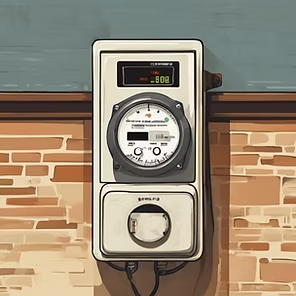
This project focuses on designing and implementing a smart energy meter capable of measuring electrical consumption in real-time and providing detailed usage data. The meter will be connected to a network, allowing remote monitoring, analysis, and optimization of energy use. It will integrate features like energy usage tracking, billing, and cost prediction to promote energy efficiency. The key component include
1.System Architecture and Design Design the architecture of the smart energy meter system, integrating the energy meter hardware, microcontroller (e.g., Arduino, Raspberry Pi), sensors, communication modules (e.g., Wi-Fi, Zigbee), and software for data collection and analysis.
2.Energy Measurement and Sensing Implement energy measurement using sensors like current transformers (CT sensors) or Hall effect sensors to detect voltage, current, and power consumption. The system will calculate active, reactive, and apparent power usage along with other metrics like power factor.
3.Real-Time Energy Monitoring Develop a real-time monitoring system that continuously tracks electricity usage, updating the data at frequent intervals. The meter will display the energy consumption (in kWh) and other relevant data on a local display (e.g., LCD, LED) and send it to a cloud server for remote access.
4.Data Communication and Remote Access Implement communication technologies such as Wi-Fi, Zigbee, or LoRaWAN for transmitting energy data to a central server or cloud platform. This allows users to access energy consumption data remotely via a smartphone app, web dashboard, or IoT platform.
5.Billing and Cost Calculation Design an automated billing system that calculates energy costs based on real-time consumption data, local electricity rates, and user-specific billing cycles. The system can generate monthly or weekly reports and send cost breakdowns directly to the user or utility provider.
6.Load Monitoring and Management Implement load monitoring capabilities to track individual appliances or devices consuming electricity. Users can get insights into which devices are consuming the most energy and take action to optimize usage, potentially integrating the system with home automation for automatic load control.
7.Energy Usage Analytics and Reports Develop an analytics system that processes collected energy data to provide usage trends, peak consumption periods, and energy-saving recommendations. Users can view reports and trends, helping them understand their consumption patterns and optimize their energy use.
8.Energy Efficiency Optimization Create algorithms to suggest energy efficiency improvements based on user consumption patterns. The system could recommend actions like turning off idle appliances, adjusting thermostat settings, or using energy-efficient devices.
9.User Interface (UI) and Control Design an intuitive user interface for monitoring and controlling the smart energy meter. This includes a local display for real-time data, a mobile app or web dashboard for remote access, and control mechanisms for settings like billing cycles, alert thresholds, and usage goals.
10.Security and Data Privacy Implement security measures to protect energy usage data and user information. This includes encryption of communication channels, secure authentication for remote access, and protection of personal and billing data.
11.Regulatory Compliance and Standards Ensure that the smart energy meter meets local and international regulations for energy metering, accuracy, and safety. The meter should comply with standards for electromagnetic interference (EMI), electrical safety, and communication protocols used in the energy sector. Technologies Energy Sensors (e.g., current transformers (CT), Hall effect sensors for real-time power measurement),Microcontrollers (e.g., Arduino, ESP32, Raspberry Pi for data processing and control),Communication Modules (e.g., Wi-Fi, Zigbee, LoRaWAN for data transmission),Display
Technologies (e.g., LCD/LED displays for local monitoring),Mobile/Cloud Platforms (e.g., Blynk, ThingSpeak, custom web apps for remote monitoring),Data Analytics Tools (e.g., machine learning algorithms for usage predictions and optimization),Security Protocols (e.g., SSL/TLS encryption, OAuth for secure remote access),Power Management Systems (e.g., algorithms for optimizing energy consumption and detecting anomalies).
Outcome A fully functional smart energy meter that allows users to monitor and control their energy consumption in real-time. The system will provide detailed insights into electricity usage, cost breakdowns, and energy-saving opportunities. It will offer remote access, automated billing, and usage analytics, enabling users to optimize their energy consumption, reduce costs, and promote energy efficiency. The system will be scalable for residential, commercial, or industrial applications and will meet the necessary regulatory standards for accuracy and safety.
This project involves designing and developing a digital notice board system that can be updated wirelessly, eliminating the need for manual interventions. It is ideal for schools, offices, public places, or any institution requiring real-time communication and announcements. The key component include
1.Wireless Communication Enable remote updates to the digital notice board through Wi-Fi, Bluetooth, or GSM modules, ensuring ease of content delivery and management.
2.Content Management System (CMS) Provide a user-friendly web or mobile interface to schedule, edit, and display text, images, or videos on the notice board.
3.Real-Time Updates Facilitate instant updates to the notice board to display emergency alerts, announcements, or changes in schedules.
4.Multiple Device Integration Support multiple digital boards connected to a single control system for synchronized content display across various locations.
5.Customizable Display Layout Allow users to design custom layouts, including sections for news, weather, announcements, and visuals.
6.Scheduling and Automation Schedule messages and announcements in advance, with the ability to automate recurring updates or time-sensitive notifications.
7.Energy Efficiency Incorporate power-saving features such as automatic brightness adjustment based on ambient light and timers to turn off the display during non-operational hours.
8.Multi-Language Support Display content in multiple languages to cater to a diverse audience.
9.Security and Access Control Ensure secure communication channels and role-based access control to prevent unauthorized updates or tampering.
10.Error Monitoring and Diagnostics Monitor the system for connectivity issues or hardware malfunctions and send alerts for troubleshooting.
Technologies Raspberry Pi or Arduino, NodeMCU (for wireless control), Python, HTML/CSS/JavaScript (for CMS), MQTT (for message handling), LCD/LED display modules, Firebase (for database and real-time updates), and power management systems.
Outcome A modern, wireless-enabled digital notice board system that streamlines communication, provides real-time updates, and improves content management while enhancing user convenience and operational efficiency.
Certifications
Get certified in Embedded Systems through our program and receive both a Training Completion Certificate and an Internship Completion Certificate. The prestigious Top Performer Certificate is awarded to outstanding students who performed exceptionally well during both the training and internship phases.



Pricing Plan
At SkillAiro, we’re committed to making high-quality education accessible to all. We’ve structured our programs with transparent and competitive pricing to suit a variety of learning needs.
Embedded Systems Industry Trends
These trends underscore India’s expanding role in the global Embedded System landscape, supported by a robust IT industry and a growing pool of skilled professionals.
5.9% Annual Growth Rate

The embedded systems sector in India is witnessing substantial growth, with projections indicating that the market will reach USD 11.9 billion by 2034. This expansion is driven by increasing demand for intelligent devices and automation across various industries. Notably, the automotive embedded systems market is expected to grow at a compound annual growth rate (CAGR) of 5.9%, reaching USD 14.4 billion globally by 2030.
Additionally, the Asia-Pacific industrial embedded systems market is projected to expand from USD 13.44 billion in 2025 to USD 19.93 billion by 2030, reflecting a CAGR of 8.2%.
Other Key Industry Trends
- The embedded systems market is projected to reach USD 11.9 billion by 2034.
- Growth is driven by initiatives such as SAMARTH Udyog Bharat 4.0, which promote awareness and adoption of automation technologies.
- The U.S. embedded systems market was valued at USD 27.3 billion in 2020 and is expected to maintain a leading position globally through 2027.
- Valued at USD 2.2 billion in 2024, Japan’s market benefits from its position as the second-largest global market for industrial robots, with 46,106 units installed in 2023.
In India, embedded systems engineers earn an average annual salary of approximately ₹4,95,000, with base salaries typically ranging from ₹3,00,000 to ₹7,00,000 per year. Entry-level positions start at around ₹3,20,000 annually, while experienced professionals can earn up to ₹10,80,000 per year.
The embedded systems industry in India is experiencing significant growth, driven by substantial investments from major technology companies. For instance, NXP Semiconductors plans to invest over $1 billion to double its R&D efforts in the country, and Taiwan’s Delta Electronics aims to nearly double its Indian workforce, expanding from 3,500 to 6,500 employees over the next five years.
INR 3-10.8 L Annual Salary

Student Testimonial

At SkillAiro, we’re committed to making high-quality education accessible to all. We’ve structured our programs with transparent and competitive pricing to suit a variety of learning needs.
Anamika ,
Web Developer
At SkillAiro, we’re committed to making high-quality education accessible to all. We’ve structured our programs with transparent and competitive pricing to suit a variety of learning needs.
Anamika ,
Web Developer
At SkillAiro, we’re committed to making high-quality education accessible to all. We’ve structured our programs with transparent and competitive pricing to suit a variety of learning needs.
Anamika ,
Web Developer
At SkillAiro, we’re committed to making high-quality education accessible to all. We’ve structured our programs with transparent and competitive pricing to suit a variety of learning needs.
Anamika ,
Web Developer
At SkillAiro, we’re committed to making high-quality education accessible to all. We’ve structured our programs with transparent and competitive pricing to suit a variety of learning needs.
Anamika ,
Web Developer
Our Alumni Work At
Our alumni are already pushing boundaries in their fields. Former students are excelling in high-profile industries and influencing the landscape of tomorrow.
RECOGNITION FROM



Frequently Asked Questions
What is a Embedded Systems training?
An Embedded Systems program equips individuals with the knowledge and skills required to design, develop, and implement embedded systems. It typically covers topics such as microcontrollers, hardware-software integration, embedded programming (using languages like C and C++), real-time operating systems (RTOS), and sensor interfacing. The program often includes hands-on projects and practical experience, preparing learners for careers as Embedded Systems Engineers, Firmware Developers, or Hardware Engineers.
What does a Embedded Systems engineer do?
An Embedded Systems Engineer designs and develops software and hardware for embedded devices, which are specialized computing systems that perform dedicated functions within a larger system. They work with microcontrollers, sensors, and actuators to create devices used in areas like automotive, healthcare, consumer electronics, and industrial automation. Embedded Systems Engineers ensure that the hardware and software work seamlessly together to deliver efficient, reliable, and secure solutions. Our embedded systems training program provides the technical expertise and hands-on experience needed to excel in this field.
Who are the instructors for this Embedded Systems training program, and how are they selected?
Our Embedded Systems trainers are experienced professionals with extensive expertise in hardware and software integration, microcontrollers, real-time operating systems (RTOS), and IoT applications. They bring hands-on experience from a wide range of industries, including automotive, consumer electronics, and industrial automation, ensuring students gain practical knowledge in developing and optimizing embedded solutions. We ensure that only trainers with exceptional alumni ratings and a proven history of delivering impactful training remain part of our faculty, providing students with the best learning experience in embedded systems and their applications.
What will be the career path after completing the Embedded Systems program online?
After completing an online Embedded Systems program, career paths include roles such as Embedded Systems Engineer, Firmware Developer, Hardware Engineer, Embedded Software Developer, or IoT Developer. With experience, you can progress to senior positions like Lead Embedded Systems Engineer, Embedded Systems Architect, or Product Development Manager. Opportunities are available in industries such as automotive, aerospace, consumer electronics, telecommunications, and industrial automation.
Which industries use Embedded Systems the most?
Embedded systems are widely used across industries such as automotive, consumer electronics, healthcare, telecommunications, aerospace, and industrial automation. Sectors like robotics, IoT, smart home technology, and manufacturing also rely heavily on embedded systems for product development and innovation. This embedded systems certification program is ideal for individuals looking to build a career in these advanced technology fields.
Can I pay the fee in installments?
Yes, you can secure your spot by paying a pre-registration fee of 1000 INR. The remaining balance can be paid before the program begins.
Will I get an internship?
Yes, at Skillairo, we offer guaranteed internship opportunities for all students across all our courses, providing hands-on experience to enhance their learning and career prospects.
How long is the training?
Our Self-paced and Mentor-led training program both last for a period of 2-3 months. Our Advanced training program last for a period of 4 months.
Talk to Expert
At Skillairo, we help students and aspiring professionals gain industry-ready skills through expert-led training, hands-on projects, internships, and career guidance.